by Joe | Apr 27, 2012 | The Next World
http://www.seattlepi.com/lifestyle/blogcritics/article/Music-Review-Joe-Deninzon-Stratospheerius-3477902.php
The Next World blogcritics.org
By Wesley Britton
Perhaps despite themselves, Joe Deninzon & Stratospheerius are proving the sub-genre of ’70s progressive rock is very much alive and well in 2012. While Stratospheerius describes itself as a “psychojazz trip funk” band, The Next World is squarely in the linage of works from bands like Yes, King Crimson, and Genesis, along with nods to jazz/rock fusion. While Deninzon doesn’t claim any of these groups as influences, citing instead musicians like Frank Zappa and Jean-Luc Ponty, The Next World seems grounded in the conventions of progressive rock, which gives Stratospheerius the ideal format to showcase their musicianship and songwriting abilities.
For example, one trend in old school prog rock was the tendency to feature lead singers with high-register tenor voices. That’s certainly true of Russian-born bandleader Deninzon. But few other frontmen also excel as masters of the electric violin. A high-flying rock band also usually requires a guitarist capable of both soaring leads and inventive and energetic chord support. For the current incarnation of the group, French fretman Aurelien Budynek does just that. In prog rock, the ensembles are normally built on the tight performances of a rhythm section capable of unusual time signatures and quick tempo changes. Bassist Jamie Bishop and drummer Lucianna Padmore fit that bill to a T.
Their The Next World album opens with the jubilant “Release,” which is about letting go of old restrictions. Tricky time signatures and interwoven vocal lines mark “The Missing Link,” showcasing an extremely psychedelic guitar solo from Budynek. The entire band becomes hopped-up speed demons on “Tech Support,” with appropriate electronic sounds to deliver the message that the singers need that elusive technical support and, “You’re my last resort.”
Offering different moods and approaches, Stratospheerius goes Appalachian on “Climbing,” which erupts into King Crimsonesque rising and falling scales, reflecting the lyrics by a singer who is “still climbing” while he ages and is “looking over my shoulder.” Crashing gongs punctuate the fusion-jazz of “Fleshbot,” which might have fit on Wired if Jeff Beck had been a fiddle master with a streak of humor.
Speaking of humor, “The House Always Wins” goes even further back in time for influences, with a bouncy, swingin’ tribute to the breed of blues you might expect in a MGM musical-that is, if violinists had been plugged in back in the day. (The bassist for this track is former band member Bob Bowen. The album is dedicated to his memory, as he died in a bicycle accident in 2010.)
The variety of styles continue to range from the rough-edged “Gods,” in which “the more the pain, the more gods we need,” to the gentle instrumental, “Ballad for Ding Bang.” After the rock jam of “Road Rage,” we get one song seemingly deliberately crafted for radio airplay, the poppy “One Foot in the Next World.” The song from which the album drew its title has the listener part in the next world, part in this life, and one part twisting the knife. To close off the album, why not add a touch of ELO-style exuberance in “The Prism”? It’s a dramatic echo of “Release” with lyrics calling for the audience to break free from what imprisons us.
Some of the publicity for The Next World might suggest the album is a Deninzon project with Stratospheerius essentially his backing band. That’s far from the case. The album does have ample samplings of Deninzon’s accomplished violin work, but Budynek’s guitars are on display in equal measure. None of the “jams” sound like spontaneous improvisations, but are rather tightly crafted studio pieces including intricately produced vocal articulations, electronic effects, and multi-tracked instrumentation. Most of the songs are five minutes or less, meaning there are few opportunities for extended demonstrations of virtuosity. It’s an album with bright, vibrant tones from four players who aren’t competing, but rather congealing.
For this release, you’re not likely to think Zappa or
Mahavishnu Orchestra, but rather Trevor Rabin, Jon Anderson, or perhaps Robert Fripp. In the end, The Next World is an album for fellow musicians to appreciate and prog rock fans to enjoy.
View the original article on blogcritics.org
http://www.seattlepi.com/lifestyle/blogcritics/article/Music-Review-Joe-Deninzon-Stratospheerius-3477902.php
by Joe | Apr 27, 2012 | Articles
Electrify Your Violin

by Joe Deninzon
A few years ago, I was asked to teach intermediate violin and beginning improvisation in the continuing education department at the New School University in New York City.
Many of the adults who came to my classes had played violin in a high school orchestra, gave it up in college as they entered their various fields, and wanted to return to the instrument and make it a part of their lives once again. Oftentimes, folks told me that, as much as they love classical music, their interests range from jazz to folk, rock, R&B, and hip-hop, and they wanted to play the music they love.
Until recently, the education system for young string players has given little attention to fostering creativity and teaching improvisation. Though the timeless beauty of the music of Mozart, Beethoven, Bach, and Stravinsky must be taught to every generation, I believe part of the reason so many young people quit playing, is because they don’t see the connection between their violin, viola, or cello and the music that is on their iPods. As a musical clinician in high schools, I see the faces of kids light up when they realize they can play any style of music on their instrument, be it hip-hop or heavy metal. This inspires them to keep playing and can even bring them back full circle to classical music, which is the foundation.
I see this same spark in adults that I have taught. If playing the violin, viola, or cello is part of your life, you may already play in a chamber group or community orchestra, but there are many avenues to explore that can inspire you, and you don’t have to live in a big city to take advantage of them.
Here are a few things you can do as a string player to expand your musical horizons:
1) Take some lessons on improvisation. I grew up in Cleveland at a time when there were no jazz violin teachers in town, but I didn’t let that stop me. Even if you live in a small town, you can find a guitarist, sax player, or pianist to teach you some basic things that you can apply to any instrument. If you just learn the pentatonic scale, blues scale, and the form of the blues, you can already wail over a wide variety of music. The blues is the foundation to 90% of popular Western music, and a major building block if your goal is to play jazz, bluegrass, or rock.
2) Play as much as you can. Conquer your fear by going to jam sessions around town. Try out some of the things you learn in your improv lesson, and accept the fact that you may not sound good right away. Just keep doing it! Get together with friends who play different instruments, throw a big party, jam and learn together.
3) Go electric. Playing violin through a microphone to be heard over a loud band just doesn’t cut it. Invest in a pickup or transducer. Companies like LR Baggs and Fishman manufacture inexpensive bridges that act as magnetic pickups connected to a quarter-inch cable jack, which is easily installed on an instrument, enabling it to connect to an amplifier or a PA system. There are also transducers, such as The Realist, which simply clip onto your bridge.
Get the Gear for Electric Violin
Electric violins and amps are such a personal choice, that I would advise trying everything you can. Here are a few suggestions:
 Transducers: If you have an acoustic violin, viola, or cello and want to invest in pickups or transducers to amplify your sound, I recommend the Realist (www.realistacoustic.com), which easily attaches to your bridge without the need to replace the bridge. Richard Barbera (www.barberatransducers.com) also makes excellent transducers used by many electric violin makers.
 Pre Amp: On my acoustic, I use a transducer made by LR Baggs (www.lrbaggs.com), which was installed in place of my regular bridge. I combine this with an LR Baggs Para Acoustic DI. This acts as a buffer between my violin and the PA system or amplifier and warms up the sound with an EQ control.
 Electric violin: For solid state electric violins, some of the well known companies are Yamaha, Wood (pictured), Jordan Electric Violins, NS, Skyinbow, and Zeta.
 AMPS: For amps, the Roland AC60 and 120 do a great job of recreating a warm acoustic tone. The Roland Jazz Chorus is a classic used by many string players. If you are more of a rock player, I recommend amps made by Bugera, Tech 21, Mesa Boogie, Kustom, and Fender.
Multi Effect processor: To add sound effects experiment with TC Electronic Nova, Boss GT-10 or GT-100 series, DigiTech RP series, Zoom G3, or Line 6 Pocket Pod (pictured below).

4) Buy electric. If you want to buy an instrument dedicated strictly to playing in an amplified setting, you need to get a solid body electric. These violins, cellos, and violas come in a wide variety of designs since the shape does not affect the sound of the instrument. They look incredible on stage! Manufacturers make four, five, six, and seven string electric violins. Having extra strings is great because you can write a string quartet and hear all four parts, or play low power chords in a rock band. Visit www.electricviolinshop.com to see some of the designs.
5) Invest in an amp. In the electric world, a good amplifier is a crucial part of your sound. Once you have electrified your instrument, go to any music store and spend an afternoon trying out every amp you can. I usually prefer guitar or bass amps for my violin, but don’t rule anything out and trust your ears.
6) Explore the world of effects pedals. The variety of pedals that exist will make your head spin. Multi-effects processors have hundreds of different sounds programmed into one device. It is a great way to introduce yourself to delay, wah, distortion—all the sounds that guitar players have used for years that many string players are now discovering for the first time.
7) Once you gain confidence, find a local band and see if they would like to add a violin, viola, or cello. So many bands in rock, pop, and hip hop are using strings that it’s becoming as common as seeing a guitar on the bandstand. DJs may invite electric violinists to accompany them at clubs.
Joe Deninzon (www.joedeninzon.com) is a violinist based in New York City who leads the band Stratospheerius, plays in the Sweet Plantain String Quartet, and has worked with artists like Bruce Springsteen, Sheryl Crow, Aretha Franklin, Ritchie Blackmore, and Phoebe Snow.

Joe Deninzon rocks out on his electric violin. For more information on electrifying your strings read his book: Plugging In: A Guide to Gear and New Techniques for the 21st Century Violinist (Mel Bay, 2012).
by Joe | Apr 24, 2012 | The Next World
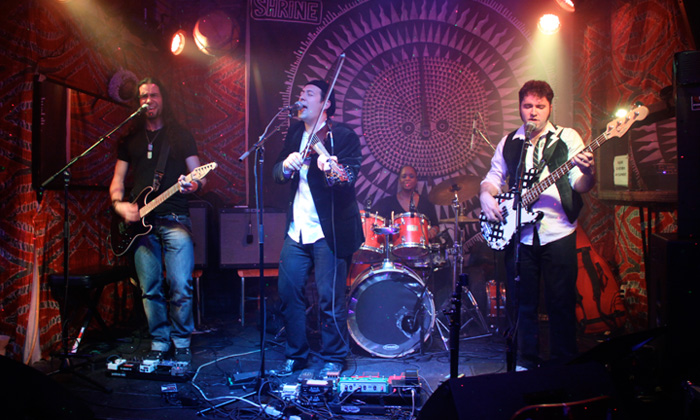
Celebrating the release of “The Next World,”
the new CD by electric violinist Joe Deninzon and Stratospheerius
THURSDAY, MAY 24TH 10 P.M.-12 A.M.
Shrine World Music Venue
2271 Adam Clayton Powell Jr. Blvd
New York, NY 10030-3003 (212) 690-7807
NO COVER! FREE SWAG!!!
Featuring:
Joe Deninzon-electric violin/lead vocals/mandolin
Aurelien Budynek-guitar
Jamie Bishop-bass
Lucianna Padmore-drums

by Joe | Apr 5, 2012 | The Next World
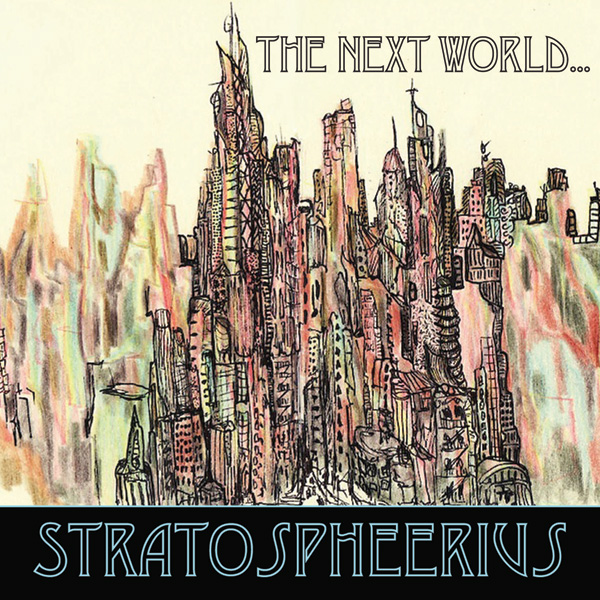
Get Lost in THE NEXT WORLD…
The New CD by Joe Deninzon & Stratospheerius
 After 3 years and thousands of delays, remixes, remasters, obsessive compulsive behavior, and lost hair, IT IS DONE!!!
The new STRATOSPHEERIUS album is HERE for your consumption
Listen to samples and download it on iTunes.
Buy it on CDBaby.
Buy it at Amazon.com.
The disc was engineered by our good friend Rave Tesar, mixed by Nic Hard (The Bravery, Sophia Ramos, The Kin), and mastered by Nathan James at The Vault in NY (Charlie Hunter, John Mayer, Garbage, Gypsy Kings). Design by Claire Deninzon.
by Joe | Jun 12, 2011 | Articles
Stratospheerius reaches for the clouds with atmospheric mix ofblues, funk, rock and more
By Steve Wildsmith
It’s difficult to say what sort of music, if any, Joe Deninzon would be playing had the Russian native’s family stayed in St. Petersburg, but one thing’s almost a certainty — it wouldn’t be the funk-blues-rock-classical concoction he does today as founder of the band Stratospheerius.
Deninzon’s family emigrated to the United States in 1979, he told The Daily Times during a recent phone interview, to escape discrimination toward Jews. He was 4 when they came to America.
“My dad wanted to leave there, wanted a better life for his kids,” Deninzon said. “We moved to Cleveland, and almost immediately my dad – who also plays violin – got a job with the Cleveland Orchestra.”
It was a given that Deninzon would wind up with a violin in his hand, given that both of his parents were classical musicians. When he was 6, his father gave him one and he began to learn to play … but American culture began to work its magic on the youngster, and listening to the radio, he fell in love with rock ‘n’ roll and, later, jazz.
“All of the sudden, violin wasn’t cool anymore,” Deninzon said. “I took up guitar and bass while still studying violin in my ‘other’ life. I took a big journey and came back to the violin.”
Two things occurred that helped change his mind. One was musician Michael Stanley, a name unfamiliar to most outside of Cleveland but something of a hometown hero to music fans there. He would consistently sell out arenas in his hometown, and his twin daughters attended school with Deninzon.
“He heard me play at one of our high school concerts, and at 16 he invited me to play with his band,” Deninzon said. “I knew the notes and the music, because I could do it on the guitar, so I just translated it to the violin. And I got a great response and some media attention from that concert.”
The second was a recording given to him by his father by the legendary Gypsy-jazz violinist Stephane Grappelli. That led to his discovery of other eclectic and groundbreaking artists, and suddenly the violin didn’t seem like such a stodgy instrument.
“Hearing some of those guys really opened my mind that you could do a lot of cool stuff on the instrument,” he said. “That was in the early 1990s, while I was still in high school, and I thought I could pave my own way with it. There were a lot of great guitar players, and I was a decent guitar player, but I wanted to stand out and do something unique.
“There was a certain sound I heard in my head that nobody else was producing, and I wanted to make it happen. It just took a few years to figure out what I wanted to play.”
He started with the rock ‘n’ roll influences with which he first fell in love on American radio — bands like Led Zeppelin, with its roots in the blues, and Yes, one of the progenitors of progressive rock. Over time, he added in the greasy funk-blues of Frank Zappa, the jazz of Miles Davis and even classical flourishes by such composers as Stravinsky and Mahler — all filtered through his violin.
“I sort of take elements from genres that I like and put them into my music while avoiding elements I don’t,” he said. “There are certain elements of the jam band scene that I love, but a lot of times there’s just aimless noodling going on. I’m a big fan of progressive rock, and I like a lot of elements of that music, but there are some elements that I don’t like.”
Eventually, he began putting together a band that would become Stratospheerius, seeking out like-minded players who thrived on a multitude of influences and genres. Combining jam, fusion, rock, progressive, jazz, metal and more, the band sounds like a condensed version of Trans-Siberian Orchestra, with vocals added. The New York-based outfit has opened for Tim Reynolds, Mickey Hart, The Slip and John Scofield, among others, and was a winner in the John Lennon Songwriting Competition.
The band’s most recent album, “Headspace,” takes all of those elements and adds even more – Middle Eastern soundscapes, singer-songwriter virtuosity and a balance between the music and the vocals that’s drawn praise from critics. Next week (on Thursday, June 16), Stratospheerius will make its East Tennessee debut in downtown Maryville, a “warm-up” for the band’s showcase the following night at Chattanooga’s annual Riverbend Festival, where the group has always enjoyed a warm reception, Deninzon said.
“Performing is one of my favorite things to do in life,” he said. “I love to be in front of the audience, and I love being spontaneous. You’ll never hear a song we do performed the same way twice. From a performance standpoint, I’m really inspired by Bruce Springsteen. I love the way he pours his whole physical being into his performances.
“We’ll record a song one way, and it’ll take on a life of its own as we perform and tour with it. And it seems to go over really well with all kinds of audiences. It’s funny, because I’m not into labels – all of the sudden that puts you in a cage, and people think of you as only one thing. If any sort of audience appreciates our music, then I’m down with it and fine with it.”
by Joe | Nov 20, 2010 | Articles
Tiles and Stratospheerius: The Old Miami 11-20-10
by Eric Harabadian
The Old Miami in Detroit’s Cass Corridor is truly one of the Motor City’s downtown venues that have stood the test of time. It’s been there through the good and the bad and the years have done nothing to erode any of this rugged institution’s charm or character. I’ve heard it likened to the long-lamented New York City alt/punk club CBGB’s and there may be something to that. Perhaps that’s one of the reasons that ground-breaking NYC violinist Joe Deninzon and Stratospheerius has been back a number of times and been embraced by the local hipsters and the cultural cognoscenti with open arms.
Electric violinist and lead vocalist Deninzon made no haste kicking their animated and adventuresome set full throttle with a tune off their Headspace album called “Long Rd.” It was an energetic rocker, with the mad fiddler front and center leading the charge as if his life depended on it. Another strange track off that same album, “Old Ghosts”, brought in a bit of funk laced with a tuneful chorus and jazzy lilt. “Today is Tomorrow” highlighted drummer Lucianna Padmore’s tabla-like flourishes and asymmetrical rhythms that gave the tune an exotic Middle Eastern feel. Another song called “Gods” showcased yet another aspect of the band’s sound where Deninzon plays his electric fiddle “bowless” in a pizzicato fashion like a guitar. “The House Always Wins” found Deninzon switching to mandolin for a gypsy blues taste, with stellar accompaniment by French guitarist Aurelien Budynek.
It seemed like Stratospheerius covered just about every kind of musical genre imaginable and the snappy ska-like “Tech Support” further displayed that notion. Bassist Jamie Bishop really propelled this one into overdrive, with some wacky and truly inspired soloing by Deninzon on the violin. As the set wound down they dedicated one of their more “prog rock” numbers “Mental Floss” to their much-anticipated gig mates Tiles. Guitarist Budynek stepped out with some ripping leads joined by cool and avante garde sound effects manipulation by Deninzon and an exceptional drum break by Padmore.